Live Streaming Platform Payment Integration Guide
Design high-concurrency payment flows, asynchronous webhook fulfillment, and risk velocity rules for live streaming, creator, and virtual gifting platforms.
Scope & readiness
Business & Capability Verification
Supported regions, card schemes, settlement cycles, and technical integration modes are verified item by item based on your merchant entity, business model, and acquiring approval.
Author
Cropay Payment Architecture Editorial Team
Fact & Compliance Review
Cropay Business & Compliance Review Group
Last Fact Review
During peak live broadcasts, users expect near-instant coin top-ups and gift delivery. Your payment integration must decouple checkout redirection from in-room wallet ledger updates using idempotent webhooks and tiered risk controls.
Key Architectural Components for Live Streaming Payments
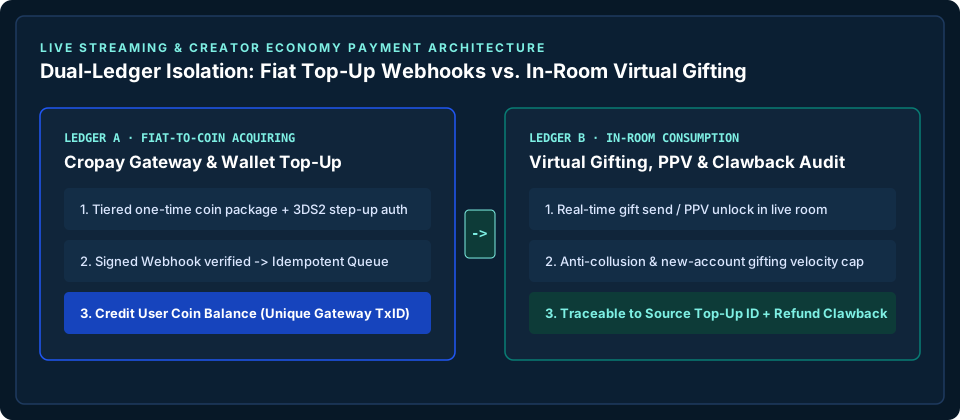
Tiered Top-Up & Package Design
Offer structured one-time top-up packages with clear exchange rates between fiat currency and in-app coins.
Low-Latency Webhook Processing
Acknowledge gateway webhooks immediately after signature verification and process wallet credits via an idempotent queue.
Pending Order Fallback Polling
If a user returns to the live room before the webhook arrives, display a brief "confirming payment" state and poll the query API.
Refund & Balance Clawback Logic
Freeze or deduct unspent virtual coins when a refund or chargeback event is triggered.
Live Streaming Top-Up & Ledger Synchronization Flow
01 Order Creation & Risk Tagging
Create a payment order with user ID, package tier, and device context while checking velocity limits.
02 Payment & 3DS2 Verification
Complete card authorization and 3DS2 authentication according to order value and risk tier.
03 Webhook Verification & Credit
Verify webhook signature, lock the order record idempotently, and credit the user’s virtual wallet.
04 In-Room Gift Consumption Audit
Record separate ledger entries when coins are spent on live gifts to maintain a complete audit trail.
Capabilities, Evidence & Compliance Boundaries
Strict Ledger Idempotency
Never credit a user wallet twice for the same gateway transaction ID, even if webhooks are retried.
No Direct Cash-Out Loops
Virtual coins purchased via card acquiring must be used for platform content/gifting and must not function as an unlicensed money transfer rail.
New Account Top-Up Caps
Apply conservative single-order and daily top-up caps for newly registered accounts to limit stolen-card exposure.
References & scope
References & Applicable Scope
Applicable Regions: Reviewed per merchant target markets and current regulatory policies
- Cropay Business Fact Baseline & Security Compliance Documentation (Verified on 2026-08-27)
Architecture blueprint
Dual-Ledger Top-Up & Virtual Gifting Payment Architecture
Risk & compliance matrix
Platform Payment Risk, Prevention & Dispute Evidence Matrix
Structured matrix of common card dispute categories, pre-authorization prevention rules, and required representment evidence.
| Dispute / Risk Category | Typical Root Cause in Digital Platforms | Pre-Auth & Checkout Prevention | Required Audit & Representment Evidence |
|---|---|---|---|
| Unauthorized Card Fraud (Stolen / Testing) | Automated card testing bots or stolen credit cards used on new accounts | Per-user/card daily velocity caps, IP/BIN screening, mandatory 3DS2 step-up | 3DS2 authentication proof (ECI/CAVV), device fingerprint, and IP logs |
| Friendly Fraud (Unrecognized Descriptor) | Cardholder does not recognize legal corporate name on bank statement | Display exact billing descriptor at checkout and send instant email receipt | Order confirmation screenshot, email receipt log, and descriptor disclosure |
| Service / Entitlement Dispute | Delayed webhook credit, unclear one-time pass duration, or hidden support | Idempotent webhook + query fallback, explicit one-time terms, fast refund link | Timestamped wallet credit ledger, login session, and feature/coin usage logs |
Industry standards & regulatory references
External Technical Standards & Compliance Authorities
EMVCo 3-D Secure (3DS2) Specification
Global technical specification for EMV 3-D Secure (3DS2) frictionless and challenge authentication flows.
PCI Security Standards Council (PCI DSS)
Payment Card Industry Data Security Standard (PCI DSS) requirements for Hosted, Embedded, and API cardholder data protection.
Office of the Privacy Commissioner for Personal Data, Hong Kong (PCPD)
Official guidance on the Personal Data (Privacy) Ordinance (Cap. 486) and cross-border data compliance in Hong Kong.
FAQ
Frequently Asked Questions
How do we prevent users from double-paying if a 3DS2 redirect takes several seconds?
Lock the checkout button while an order is pending and use a clear "verifying payment status" spinner upon return.
What happens if a user requests a refund after spending part of their virtual coins?
Your refund policy should clearly state rules for partially consumed coin packages, and your support team should verify ledger balances before approving refunds.
Can we embed the checkout inside a mobile WebView?
Yes, provided the WebView properly supports 3DS2 bank challenge redirects and HTTPS security standards.
Business assessment
Request a Live Streaming Payment Integration Review
Submit your corporate entity, website or app URL, target markets, billing items, transaction model, and preferred integration mode for a structured onboarding review.
Submit Onboarding Assessment