Integrable International Payment Gateway & API Architecture
Unified payment gateway supporting Hosted Checkout, Embedded flows, and REST APIs—connecting order creation, 3DS2 authentication, webhooks, and refunds.
Scope & readiness
Business & Capability Verification
Supported regions, card schemes, settlement cycles, and technical integration modes are verified item by item based on your merchant entity, business model, and acquiring approval.
Capability definition
Capability Definition & Scope
A reliable payment gateway isolates your core application from channel complexity. Cropay provides standardized order state machines, idempotent API design, signed asynchronous webhooks, and clear error codes across Web and mobile environments.
Use cases
Applicable Use Cases
- Hosted Payment Page
- Embedded Checkout Experience
- Server-to-Server Order & Refund APIs
- Signed Asynchronous Webhooks
Transaction types
Verified Transaction Scope
- User-initiated one-time transactions
- Refunds, cancellations, and status queries (subject to verified channel scope)
- Excludes automated recurring billing or self-serve subscription management
Integration modes
Integration Modes
Hosted
Best for platforms preferring gateway-hosted payment pages.
Embedded
Best for platforms requiring an in-page experience with corresponding security controls.
API
Best for server-side order creation, status queries, refunds, and webhook integration.
Process steps
Integration & Processing Workflow
- 01
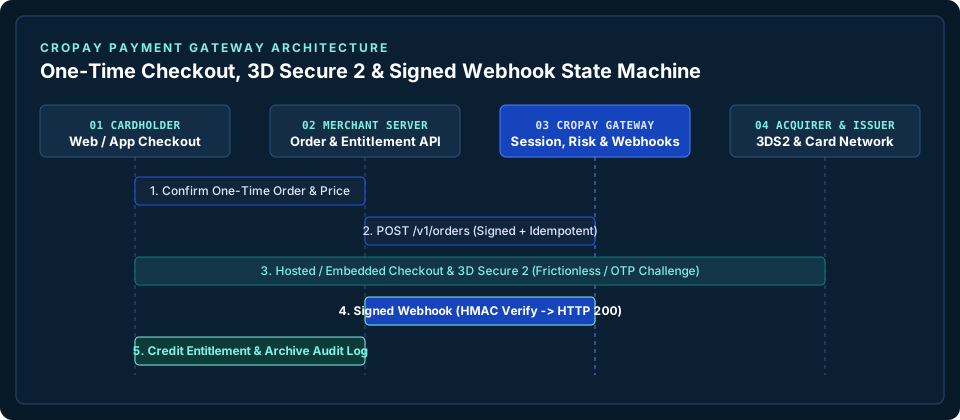
01 Server Order Creation
Your backend submits merchant order ID, amount, currency, return URL, and webhook URL to create a payment session.
- 02
02 Customer Checkout & 3DS2
The cardholder completes payment authorization and 3DS2 authentication via Hosted or Embedded checkout.
- 03
03 Webhook Signature Verification
Your server validates the webhook signature and idempotently updates the order status before fulfilling digital goods.
- 04
04 Reconciliation & Refund Sync
Query order statuses for edge cases and synchronize refund or dispute events with your internal ledger.
Verified Scope & Limitations
Verified Supported Scope
Integration Options: Hosted Checkout, Embedded checkout components, and RESTful APIs State Reliability: Idempotent requests, signed webhooks, and active order status query endpoints Security Prerequisite: Integration mode selection must match merchant PCI DSS compliance scope
Limitations & Boundaries
Browser return URLs only indicate user navigation; order fulfillment must always rely on verified server webhooks or API queries. Direct handling of raw cardholder data requires corresponding PCI DSS certification; most merchants should use Hosted or tokenized flows. All merchants must pass signature, webhook retry, timeout, and refund tests in sandbox prior to receiving live credentials.
Gateway sequence diagram
One-Time Checkout, 3DS2 & Signed Webhook Sequence Architecture
Technical comparison matrix
Hosted vs. Embedded vs. Server API Integration Comparison
Comparison of Cropay payment gateway integration modes across PCI DSS compliance scope, 3DS2 handling, and engineering effort.
| Integration Mode | PCI DSS Scope | Checkout UX & Control | 3DS2 & Webhook Flow | Recommended Platform Scenario |
|---|---|---|---|---|
| Hosted Checkout | Lowest (SAQ A eligible; gateway hosts card entry) | Redirect to Cropay-hosted responsive checkout page | Gateway manages 3DS2 redirect; server verifies signed webhook | Fast cross-border launch for web & mobile dating/streaming platforms |
| Embedded Checkout | Moderate (requires approved security & domain review) | In-page embedded payment component within merchant UI | Component handles 3DS2 challenge frame + server webhook confirmation | Platforms requiring uninterrupted in-app/in-room top-up experience |
| Server-to-Server API | Strictest (requires full PCI DSS certification if handling raw PAN) | Full custom merchant-controlled order & status orchestration | Idempotent REST session creation + HMAC/RSA webhook + query API | High-concurrency wallet ledgers, automated refund & reconciliation sync |
Integration payload & webhook blueprint
One-Time Payment Session & Signed Webhook Reference Pattern
Architectural payload pattern illustrating idempotent one-time order creation and server-side webhook verification. Live sandbox endpoints and merchant keys are issued after business pre-review.
1. POST /v1/payment-sessions (Server-to-Server)
{
  "merchantOrderId": "ord_20261026_98231",
  "idempotencyKey": "idem_7f83b165-4a2b-4c9e",
  "amount": "29.99",
  "currency": "USD",
  "captureMethod": "automatic",
  "transactionModel": "one_time_user_initiated",
  "threeDSecure": { "mode": "dynamic_step_up" },
  "productContext": {
    "itemCode": "coin_pack_300",
    "itemDescription": "300 Virtual Coins (One-Time Purchase)"
  },
  "returnUrl": "https://merchant.example.com/checkout/return",
  "webhookUrl": "https://merchant.example.com/api/webhooks/cropay"
}
2. Signed Asynchronous Webhook Event (payment.succeeded)
// Header: X-Cropay-Signature: t=1761472800,v1=hmac_sha256(secret, t + "." + rawBody)
{
  "eventId": "evt_01J9Z8K4M2P5X",
  "eventType": "payment.succeeded",
  "gatewayTransactionId": "txn_cp_88492019",
  "merchantOrderId": "ord_20261026_98231",
  "amount": "29.99",
  "currency": "USD",
  "threeDSecureResult": {
    "version": "2.2.0",
    "authenticated": true,
    "flow": "frictionless"
  },
  "capturedAt": "2026-10-26T09:00:00Z"
}
FAQ
Frequently Asked Questions
Should we choose Hosted Checkout or Embedded integration?
Hosted Checkout is recommended for faster launch and lower PCI compliance scope; Embedded flows require additional security review.
How should our system handle delayed or duplicate webhooks?
Design your webhook handler to verify signatures first and process events idempotently using unique transaction IDs.
When can our engineering team access the full API reference?
Detailed API endpoints, sandbox keys, and webhook schemas are provided once initial business pre-review is completed.
Business assessment
Discuss Payment Gateway Integration for Your Platform
Submit your corporate entity, website or app URL, target markets, billing items, transaction model, and preferred integration mode for a structured onboarding review.
Submit Onboarding Assessment