3D Secure 2 (3DS2) Payment Authentication Guide for Digital Platforms
Learn how 3D Secure 2 works, when frictionless vs. challenge flows occur, how fraud protection applies, and how to handle 3DS2 redirects in web and mobile apps.
Scope & readiness
Business & Capability Verification
Supported regions, card schemes, settlement cycles, and technical integration modes are verified item by item based on your merchant entity, business model, and acquiring approval.
Author
Cropay Payment Architecture Editorial Team
Fact & Compliance Review
Cropay Business & Compliance Review Group
Last Fact Review
3D Secure 2 (3DS2) is a cornerstone of international card acquiring security. By sharing richer contextual data with issuing banks, 3DS2 enables frictionless authentication for low-risk orders while enforcing step-up verification for high-risk transactions.
How 3D Secure 2 Impacts Platform Payments
Frictionless vs. Challenge Routing
Issuing banks evaluate device, transaction, and risk data to either approve silently or prompt the cardholder for OTP/biometric verification.
Unauthorized Fraud Protection
Successful 3DS2 authentication verifies cardholder participation and helps defend against "unauthorized transaction" claims.
Mobile & WebView Compatibility
Ensure mobile apps and in-app browsers properly handle bank challenge redirects and return callbacks without losing session state.
Selective Risk Step-Up
Enforce mandatory 3DS2 on first-time cards, high-value top-ups, or velocity anomalies.
3DS2 Transaction Lifecycle
01 Initiate Payment & Risk Context
Submit order details and browser/device context to the payment gateway.
02 Issuer Risk Assessment
The card network and issuing bank determine whether frictionless approval or a cardholder challenge is required.
03 Challenge Completion & Authorization
If challenged, the user completes verification; the gateway then proceeds with payment authorization.
04 Webhook Result & Evidence Archival
Receive the final authorization and 3DS2 status via webhook and store the authentication record.
Capabilities, Evidence & Compliance Boundaries
Issuer Final Decision
Whether a transaction triggers a challenge or is approved ultimately depends on the cardholder’s issuing bank.
Not a Substitute for Clear Terms
Even with 3DS2, unclear billing descriptors or poor refund support will still generate friendly fraud disputes.
Channel-Specific Rules
3DS2 enforcement policies vary by acquiring channel, card brand, and issuing region.
References & scope
References & Applicable Scope
Applicable Regions: Reviewed per merchant target markets and current regulatory policies
- Cropay Business Fact Baseline & Security Compliance Documentation (Verified on 2026-08-27)
Risk & 3DS2 architecture
Four-Stage Fraud Screening, 3DS2 & Chargeback Defense Architecture
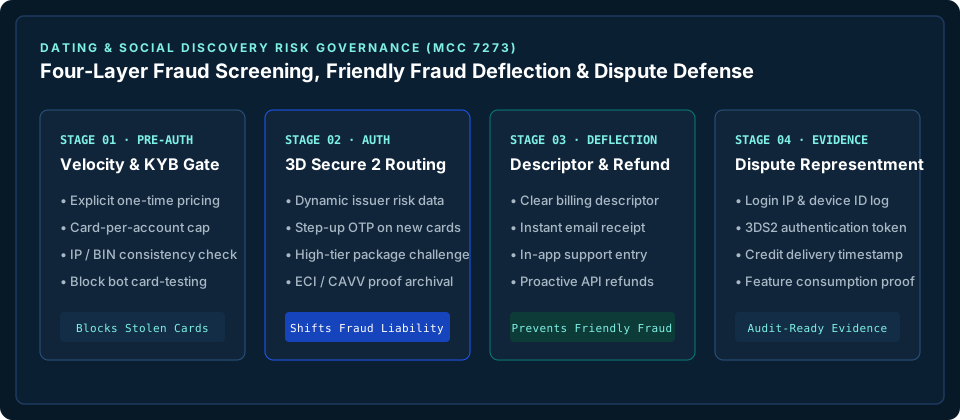
Risk & compliance matrix
Platform Payment Risk, Prevention & Dispute Evidence Matrix
Structured matrix of common card dispute categories, pre-authorization prevention rules, and required representment evidence.
| Dispute / Risk Category | Typical Root Cause in Digital Platforms | Pre-Auth & Checkout Prevention | Required Audit & Representment Evidence |
|---|---|---|---|
| Unauthorized Card Fraud (Stolen / Testing) | Automated card testing bots or stolen credit cards used on new accounts | Per-user/card daily velocity caps, IP/BIN screening, mandatory 3DS2 step-up | 3DS2 authentication proof (ECI/CAVV), device fingerprint, and IP logs |
| Friendly Fraud (Unrecognized Descriptor) | Cardholder does not recognize legal corporate name on bank statement | Display exact billing descriptor at checkout and send instant email receipt | Order confirmation screenshot, email receipt log, and descriptor disclosure |
| Service / Entitlement Dispute | Delayed webhook credit, unclear one-time pass duration, or hidden support | Idempotent webhook + query fallback, explicit one-time terms, fast refund link | Timestamped wallet credit ledger, login session, and feature/coin usage logs |
Industry standards & regulatory references
External Technical Standards & Compliance Authorities
EMVCo 3-D Secure (3DS2) Specification
Global technical specification for EMV 3-D Secure (3DS2) frictionless and challenge authentication flows.
PCI Security Standards Council (PCI DSS)
Payment Card Industry Data Security Standard (PCI DSS) requirements for Hosted, Embedded, and API cardholder data protection.
Office of the Privacy Commissioner for Personal Data, Hong Kong (PCPD)
Official guidance on the Personal Data (Privacy) Ordinance (Cap. 486) and cross-border data compliance in Hong Kong.
FAQ
Frequently Asked Questions
Why do some users see an OTP challenge while others complete checkout instantly?
In 3DS2, the issuing bank dynamically assesses risk; trusted low-risk transactions pass via the frictionless flow, while higher-risk orders require a challenge.
What happens if a user closes the browser window during the 3DS2 bank challenge?
The authorization will not complete and the order will expire or fail; your system should rely on server webhooks or status queries rather than crediting the order.
Does 3DS2 guarantee we win every chargeback?
No. It provides strong evidence against unauthorized fraud reason codes, but does not override disputes regarding unfulfilled services or refund promises.
Business assessment
Optimize Your 3DS2 Authentication & Checkout Flow
Submit your corporate entity, website or app URL, target markets, billing items, transaction model, and preferred integration mode for a structured onboarding review.
Submit Onboarding Assessment