Virtual Gifting, Coin Top-Ups & Tipping Payment Architecture Guide
How to structure virtual currency top-ups, live gifting confirmations, anti-fraud velocity rules, and dispute evidence for creator and live streaming platforms.
Scope & readiness
Business & Capability Verification
Supported regions, card schemes, settlement cycles, and technical integration modes are verified item by item based on your merchant entity, business model, and acquiring approval.
Author
Cropay Payment Architecture Editorial Team
Fact & Compliance Review
Cropay Business & Compliance Review Group
Last Fact Review
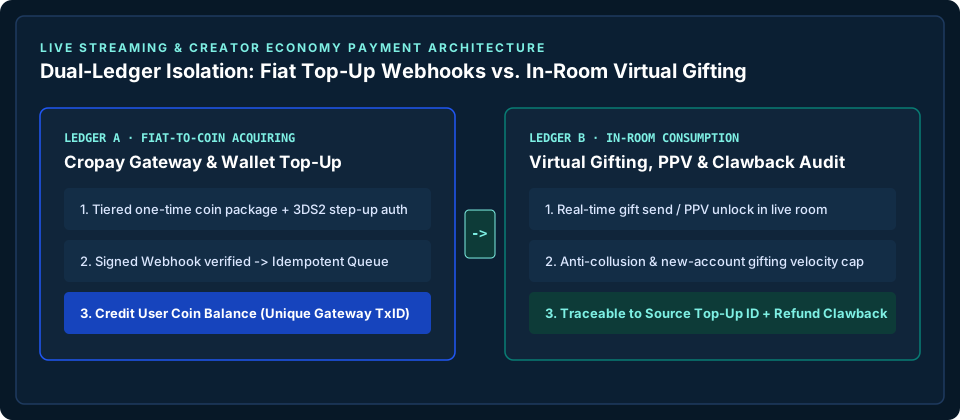
Virtual gifting typically involves two distinct steps: purchasing platform coins with fiat currency, and sending virtual gifts inside a live stream. Separating these two ledgers while maintaining end-to-end traceability is essential for risk control and compliance.
Core Design Principles for Virtual Gifting Payments
Transparent Coin Pricing & Terms
Clearly display fiat prices, coin quantities, any bonus coins, and refund conditions before payment confirmation.
Anti-Collusion & Velocity Controls
Monitor abnormal patterns where newly registered accounts top up with multiple cards and immediately tip a single creator.
High-Value Top-Up Step-Up Auth
Require 3D Secure 2 authentication and account verification for large top-up packages.
Traceable Consumption Logs
Link every virtual gift transaction back to the originating top-up order ID for audit and dispute defense.
Safe Lifecycle of a Virtual Top-Up & Gift
01 Package Selection & Disclosure
User selects a one-time coin package and confirms the price and non-automatic renewal terms.
02 Risk Check & Card Payment
Gateway executes velocity checks and 3DS2 authentication before capturing the payment.
03 Wallet Credit & Cooling Rules
Coins are credited upon webhook confirmation; optional risk holds may apply to first-time high-value top-ups.
04 Gift Delivery & Audit Archival
In-room gift delivery records timestamp, sender, recipient, and coin deduction in an immutable log.
Capabilities, Evidence & Compliance Boundaries
Prevent Money Laundering & Self-Tipping
Platforms must monitor and block self-tipping or collusive cash-out rings using stolen credit cards.
Clear Refund Rules for Virtual Currency
Publish clear terms explaining how unused vs. consumed virtual coins are handled in refund requests.
No Unverified Payout Promises
Cropay processes incoming card payments for the merchant platform and does not manage downstream creator payouts.
References & scope
References & Applicable Scope
Applicable Regions: Reviewed per merchant target markets and current regulatory policies
- Cropay Business Fact Baseline & Security Compliance Documentation (Verified on 2026-08-27)
Architecture blueprint
Dual-Ledger Top-Up & Virtual Gifting Payment Architecture
Risk & compliance matrix
Platform Payment Risk, Prevention & Dispute Evidence Matrix
Structured matrix of common card dispute categories, pre-authorization prevention rules, and required representment evidence.
| Dispute / Risk Category | Typical Root Cause in Digital Platforms | Pre-Auth & Checkout Prevention | Required Audit & Representment Evidence |
|---|---|---|---|
| Unauthorized Card Fraud (Stolen / Testing) | Automated card testing bots or stolen credit cards used on new accounts | Per-user/card daily velocity caps, IP/BIN screening, mandatory 3DS2 step-up | 3DS2 authentication proof (ECI/CAVV), device fingerprint, and IP logs |
| Friendly Fraud (Unrecognized Descriptor) | Cardholder does not recognize legal corporate name on bank statement | Display exact billing descriptor at checkout and send instant email receipt | Order confirmation screenshot, email receipt log, and descriptor disclosure |
| Service / Entitlement Dispute | Delayed webhook credit, unclear one-time pass duration, or hidden support | Idempotent webhook + query fallback, explicit one-time terms, fast refund link | Timestamped wallet credit ledger, login session, and feature/coin usage logs |
Industry standards & regulatory references
External Technical Standards & Compliance Authorities
EMVCo 3-D Secure (3DS2) Specification
Global technical specification for EMV 3-D Secure (3DS2) frictionless and challenge authentication flows.
PCI Security Standards Council (PCI DSS)
Payment Card Industry Data Security Standard (PCI DSS) requirements for Hosted, Embedded, and API cardholder data protection.
Office of the Privacy Commissioner for Personal Data, Hong Kong (PCPD)
Official guidance on the Personal Data (Privacy) Ordinance (Cap. 486) and cross-border data compliance in Hong Kong.
FAQ
Frequently Asked Questions
Why do fraudsters target live streaming gift systems?
Because stolen card funds can be quickly converted into virtual gifts for accomplice streamer accounts if velocity and payout holds are not enforced.
How can platforms protect against collusive gifting fraud?
Enforce 3DS2 on top-ups, cap daily top-ups for new users, and apply settlement cooling periods before creators can withdraw earnings.
Should users buy gifts directly with a card or top up coins first?
Both models work, but a clear order confirmation and traceable ledger between payment and gift delivery are required in either design.
Business assessment
Evaluate Your Virtual Gifting & Top-Up Payment Flow
Submit your corporate entity, website or app URL, target markets, billing items, transaction model, and preferred integration mode for a structured onboarding review.
Submit Onboarding Assessment